Why Your Gym Towel Is What Makes Your Activewear Smell
Quick Answer: Towels are thick, absorbent cotton that stays damp far longer than synthetic activewear and holds detergent and softener residue in its loops. Washed together, a towel acts as a reservoir that re-deposits bacteria and residue onto your synthetics — and its lint clogs the fibres that make activewear breathe. Wash towels separately, on a hotter cycle, and never use fabric softener on either.
If you have been fighting permastink in your leggings for months and nothing works, look at what else is in the drum.
The towel is doing more damage than the workout.
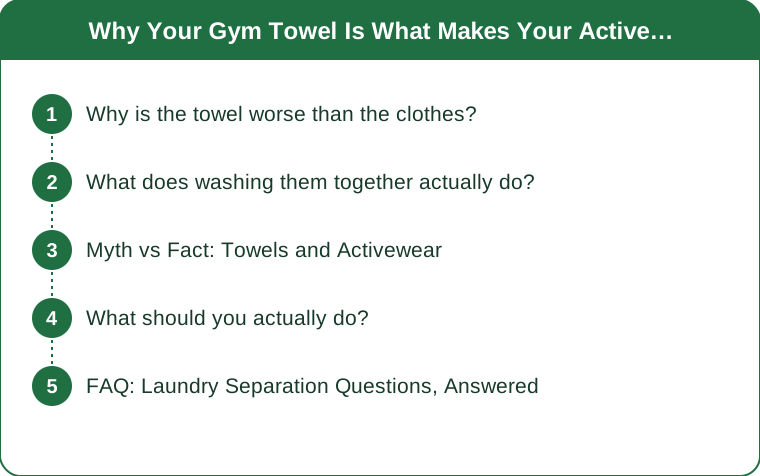
Why is the towel worse than the clothes?
Because of what it is made of and how long it stays wet.
Thickness and drying time. A terry towel holds several times its own weight in water and can stay genuinely damp in a gym bag or on a hook for many hours. Bacteria that produce odour compounds multiply in exactly that condition. Your synthetic top, by contrast, is often dry within an hour.
Absorbency means it collects everything. Sweat, skin cells, body oils, residue from gym equipment, and whatever was on the bench. That is its job. It also makes it the dirtiest item in the load by a wide margin.
The loops hold residue. Terry loops trap detergent and any softener you use, and that residue is itself food for bacteria and a barrier that stops water reaching the fibre in later washes.
It sheds lint constantly. Cotton lint transfers onto synthetics in the drum and works into the knit structure. Once there, it holds moisture against a fabric engineered to move moisture away — which both reduces performance and creates a damper microclimate for bacteria.
So the towel is simultaneously the dirtiest item, the residue reservoir, and the lint source. Putting it in with your activewear undoes most of what you were trying to achieve.
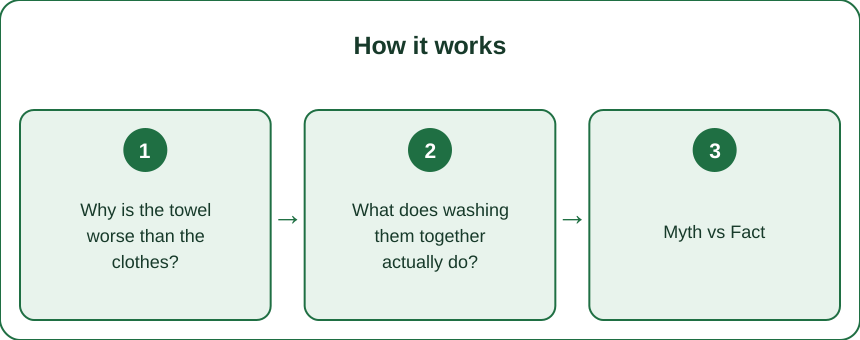
What does washing them together actually do?
Three specific harms, in order of how much they matter:
1. Lint contamination. This is the underrated one. Cotton lint embeds in the knit of synthetic fabrics, reduces wicking, and holds odour. You can often see it as a faint fuzz on dark leggings after a few shared washes. Once embedded, it is difficult to fully remove.
2. Temperature mismatch. Towels need heat to be properly hygienic — commonly 60°C or the equivalent hot cycle. Most activewear should be washed at 30°C or cold to protect elastane and printed detail. Wash together and one of them is wrong. In practice people run the cool cycle, which means the towel never actually gets clean, which means the smell survives to the next wash.
3. Mechanical abrasion. Heavy wet towels tumbling against light synthetics increases pilling and wear. A load of towels is one of the harshest environments in your machine.
There is a fourth issue that shows up over months: a load dominated by heavy cotton absorbs a disproportionate share of the detergent, leaving the synthetics under-cleaned in the same cycle.
Myth vs Fact: Towels and Activewear
Myth: If it comes out smelling clean, it is clean. Fact: Fragrance masks odour compounds without removing the bacteria producing them. The classic sign is fabric that smells fine in the cupboard and turns sour within ten minutes of wearing — the bacteria survived and your body heat woke them up.
Myth: Fabric softener helps towels stay soft. Fact: Softener coats fibres with a waxy layer that reduces absorbency in towels and destroys wicking in activewear. It is the single worst product for both categories, and it makes odour worse in both by giving bacteria a residue layer to live in.
Myth: Hot water damages activewear so cold is always right. Fact: Cold is correct for the synthetics and insufficient for the towels. That is not a compromise to split — it is a reason to run two loads.
Myth: More detergent gets a smelly towel cleaner. Fact: Excess detergent does not rinse out of terry loops and becomes residue, which holds moisture and feeds bacteria. Overdosing is one of the more common causes of a persistently sour towel.
Myth: The washing machine cleans itself. Fact: A machine that has run cool cycles with heavy cotton for months develops biofilm in the drum and gasket, and that biofilm re-contaminates every load. If everything smells slightly off, suspect the machine before the clothes.
What should you actually do?
Separate the loads. This is the whole answer, and everything else is refinement.
For towels:
- Wash at 60°C or the hot cycle, which is the temperature that actually addresses bacteria
- No fabric softener, ever. If towels feel stiff, half a cup of white vinegar in the rinse compartment softens without coating
- Do not overload — towels need room to move for water to penetrate the loops
- Dry fully and promptly. A towel left damp in the machine for six hours has undone the wash
- Hang spread out, not folded over a hook, so both faces dry
For activewear:
- Cold or 30°C, inside out, with the rest of your synthetics only
- Modest detergent — less than the label says, and no softener
- Do not leave it in the machine. Out and hung within the hour
- An occasional pre-soak in water with a splash of vinegar helps with existing odour, though it will not remove embedded lint
For the machine, monthly: run an empty hot cycle, wipe the gasket, and leave the door ajar between uses. This costs ten minutes and prevents the problem that makes everything else pointless.
And for the gym bag: get the towel out of it the moment you are home. A damp towel in a closed bag for four hours does more to it than the workout did.
FAQ: Laundry Separation Questions, Answered
Can I wash microfibre gym towels with activewear?
Better than cotton, since there is no lint transfer and both are synthetic. But microfibre towels also hold moisture and odour and often need a hotter wash than leggings tolerate. Separate is still better; this combination is the least bad exception.
How often should gym towels be washed?
After every use if they got genuinely sweaty. A gym towel is not a bath towel — it has been on shared equipment and against sweat, and reusing it is the most common reason people cannot solve a persistent smell.
Will a second wash fix already-smelly activewear?
Sometimes, if the cause is residue rather than embedded lint. A soak in water with white vinegar for 30 minutes before a normal cold wash is the most effective home approach. Embedded cotton lint is much harder to reverse, which is why separation is preventive rather than curative.
Does an antibacterial laundry additive help?
It can, particularly for towels washed at lower temperatures where heat is not doing the work. It is not a substitute for separating loads, drying promptly, and cutting the detergent dose — and if the machine itself has biofilm, no additive fixes that.
TL;DR:
- Towels stay damp longest, hold the most residue, and shed cotton lint that clogs the fibres activewear relies on to breathe.
- Towels need hot water; activewear needs cold — those cannot be reconciled in one load.
- Never use fabric softener on either, and use less detergent than the label suggests.
- Dry both promptly, and run a monthly empty hot cycle to keep the machine from re-contaminating everything.
Run two loads instead of one. It is the least interesting fix on this list and it solves more than any product will.
See It in Motion
Seen here: Super High Waist Embossed Yoga Leggings with Inner Pocket — shop it on bubblelime.com
Keep Reading
This article is for general informational and styling purposes only. Fit, sizing, and product availability may vary.