Why Indoor Drying in Autumn Changes How Activewear Smells
Quick Answer: Synthetic fabrics hold onto the oils and bacteria that cause odour, and both need heat, agitation and fast drying to be fully removed. When clothes take twelve hours to dry on a rack in a closed autumn room instead of two hours in summer air, bacteria have a long warm damp window to multiply in fabric that is already holding residue. The smell appears when you put the garment on and body heat releases it. Faster drying and a periodic hot wash fix it; more detergent does not.
They came out of the machine smelling of nothing at all.
You put them on two days later, warmed up for ten minutes, and there it was again.

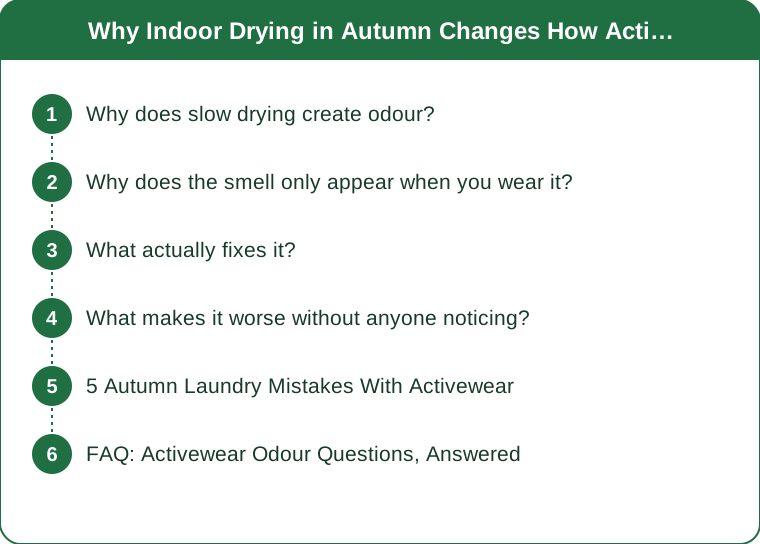
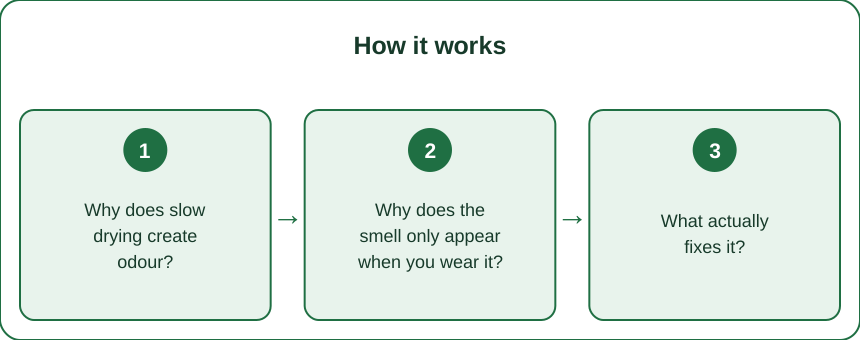
Why does slow drying create odour?
Bacteria multiply in damp fabric, and slow drying extends the window in which they can.
A rack in a closed autumn room is a poor drying environment - high humidity, no air movement, and moderate temperature, which is close to ideal for microbial growth.
Synthetics dry faster than cotton in good conditions and hold odour compounds more tightly, so a slow dry affects them disproportionately.
The classic damp smell in the fabric is the first sign, and it usually indicates drying took too long rather than a washing failure.
Twelve hours is the rough threshold where noticeable odour development becomes common.
Which is why the same wash routine that worked in July produces a different result in October.
Why does the smell only appear when you wear it?
Odour compounds sit in the fabric until heat and moisture release them, and body heat plus sweat provides both.
Synthetic fibres are oleophilic - they attract and hold body oils, which is where much of the odour-producing material lives.
Cool water washing does not remove those oils fully, so residue accumulates wash after wash while the garment appears clean.
Bacteria feed on that residue and produce the compounds you eventually smell.
Which is why a garment can smell perfectly fine in the drawer and unmistakable ten minutes into a workout.
And it is a cumulative problem - the smell appears earlier and earlier as residue builds up over months.
What actually fixes it?
Dry faster. Air movement matters more than heat - a fan aimed at the drying rack cuts drying time dramatically at negligible cost.
Ventilate the room while clothes dry, since the air has to have somewhere to put the moisture.
Space the garments out, because overlapping fabric on a crowded rack can double the drying time.
Wash promptly. Damp workout clothes in a bag or basket for a day is where most of the bacterial load originates, and hanging them to air until wash day makes a large difference.
Do a periodic hot wash - once every few weeks at 140F where the care label permits - which removes the accumulated oil residue that cool washes leave.
And a white vinegar soak for 30 minutes before washing rescues garments that have already developed persistent odour.

What makes it worse without anyone noticing?
Fabric softener, which coats synthetic fibres, traps residue and reduces wicking. It is the single worst product for activewear.
Too much detergent, which does not rinse out fully and leaves a residue that holds odour, particularly in high-efficiency machines.
Overloading the machine, which prevents proper agitation and rinsing.
Drying near a radiator in a closed room, which is warm and humid at the same time - the worst combination.
Leaving the washing machine door closed, since a damp drum grows the mould that transfers straight onto the next load.
And drying in a bathroom, which is the most humid room in the house and the most common place people put a rack in autumn.
5 Autumn Laundry Mistakes With Activewear
1. Moving the drying rack into the smallest closed room. The instinct is to keep it out of the way, and the result is a room at 80 percent humidity where nothing dries. Air movement is what dries clothes, not warmth - a fan and a cracked window beat a closed warm room every time.
2. Adding more detergent because things smell. Excess detergent does not rinse out and becomes food for the bacteria producing the smell. The fix is usually less detergent plus a hot wash, not more of the same.
3. Leaving damp kit in a bag until laundry day. A sealed gym bag at room temperature for 24 hours produces a bacterial load that a cool wash will not clear. Hang it up as soon as you get home, even unwashed.
4. Using fabric softener on technical fabric. It coats fibres, traps oils, reduces wicking and makes the smell problem permanent. Half a cup of white vinegar in the rinse does everything people want softener for, without the coating.
5. Never washing hot. Cool washing is right for elastane longevity and it leaves body oils behind. A periodic wash at 140F, where the label allows, clears the accumulation and resets the garment.
And the bonus: forgetting the machine itself. A monthly hot empty cycle with the drum cleaner, plus wiping the gasket and leaving the door ajar, prevents the machine from becoming the source. Autumn is when the machine sits in a closed damp utility room, which is exactly when this starts.
FAQ: Activewear Odour Questions, Answered
How hot can I wash activewear?
Follow the care label. Many synthetics tolerate 140F occasionally, which is enough to remove accumulated oils, while regular hot washing shortens elastane life.
Does vinegar damage technical fabric?
Diluted white vinegar in the rinse or as a pre-soak is generally safe on synthetics. Avoid it on anything with a specialised water-repellent finish unless the manufacturer says otherwise.
Should I use a sports detergent?
They are formulated to lift body oils from synthetics and are genuinely more effective on persistent odour than standard detergent.
How long is too long for drying indoors?
Beyond about twelve hours you start seeing odour development. A fan usually brings a rack of activewear well under that.
Can I tumble dry activewear?
Occasionally on low. Heat degrades elastane permanently, so air drying with air movement is better for longevity - the goal is fast air drying, not the dryer.
Why does my washing machine smell?
Biofilm in the drum and gasket from cool washes. A monthly hot empty cycle with a drum cleaner, plus leaving the door open, resolves it.
TL;DR:
- Slow indoor drying gives bacteria a long damp window in fabric that already holds body oils.
- The smell releases when body heat warms the garment, which is why it appears mid-workout.
- Air movement dries clothes faster than warmth - use a fan, space garments out, and ventilate.
- Hang damp kit immediately instead of leaving it in a bag; that is where the bacterial load starts.
- Skip fabric softener, use less detergent, and run a hot wash every few weeks where the label allows.
Your washing did not stop working. Your drying did.
Keep Reading
This article is for general informational and styling purposes only. Fit, sizing, and product availability may vary.