Why Sports Bras Wear Out Faster Than Your Leggings
Quick Answer: Sports bras fail faster because they rely on elastic recovery rather than fabric integrity, and elastane degrades from heat, body oil and being stored stretched. A legging can lose 20 percent of its stretch and still look and work fine. A bra that loses 20 percent of its recovery has lost most of its support, which is its only job.
Same purchase date, same wash cycle, same drawer.
The leggings look new. The bra has gone soft, the band rides up, and it no longer holds you the way it did.
The bra did not fail early. It has a much lower failure threshold, and everything about the way most people wash and store them accelerates it.
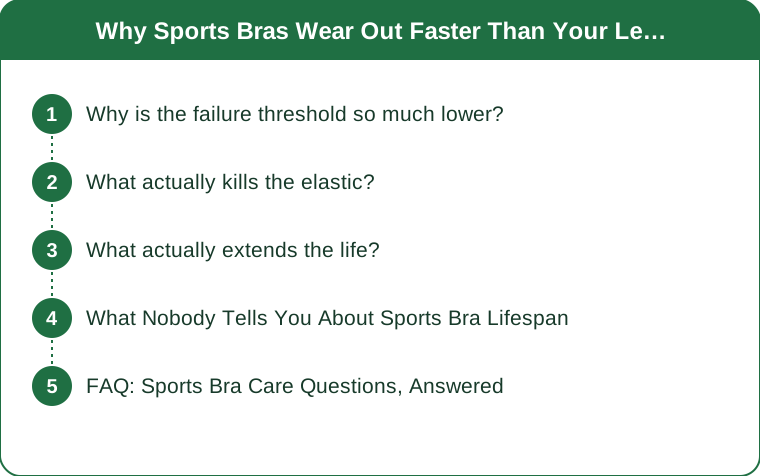
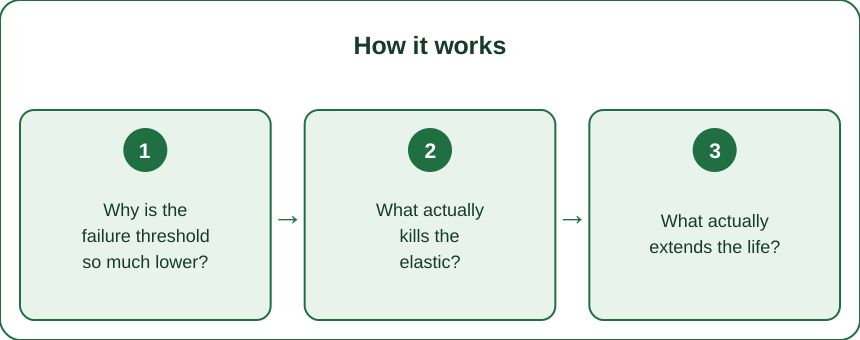
Why is the failure threshold so much lower?
Because support is a recovery property, and recovery degrades before appearance does.
Elastane — the fiber that provides stretch, whether it is branded as spandex or Lycra — works by stretching and returning. Over time it returns less completely. This is normal and gradual, and it is measured as loss of recovery rather than loss of stretch.
For leggings, moderate recovery loss is barely noticeable. The fabric still covers, still moves with you, maybe bags slightly at the knee. They stay functional well past the point of measurable degradation.
For a sports bra, recovery is the function. The band supplies the large majority of support in most designs — commonly cited around 80 percent — and the band works by staying tight. Once the band’s elastic no longer returns to its original length, the bra is not doing the thing you bought it for, even though it looks completely fine.
That is the disconnect. A bra can be visually perfect and functionally finished. There is no fraying, no thinning, no fading to warn you. Support just quietly goes.
What actually kills the elastic?
Four things, in order of how much damage they do.
Heat. By a wide margin the biggest factor. Hot water, and especially tumble drying, breaks down elastane. A dryer’s heat does more damage in one cycle than several weeks of wear. This is the single change with the largest effect on lifespan.
Body oils and sweat residue. Oils degrade elastane over time, and they are not fully removed by cold water alone if the garment sits. Leaving a sweaty bra in a bag or a hamper for two days is materially worse than washing it promptly — and it is also the main cause of the smell that will not wash out.
Being stored stretched. Hanging a bra by its straps, or folding one cup into the other so the fabric is permanently under tension, keeps the elastic extended when it should be resting. Elastic left extended recovers less. Store bras flat or side by side, unfolded.
Fabric softener and chlorine. Softener coats fibers and reduces both wicking and elasticity. Chlorine attacks elastane directly, which is why swim-worn garments age fastest of all.
What does not matter much: wearing it often. Wear cycles matter far less than heat and storage. Two bras rotated with good care outlast four bras that live in a dryer.

What actually extends the life?
A short routine that roughly doubles the useful life of a good bra.
Wash cold, always. Cold water is sufficient for sweat and it does not attack elastane. There is no version of this where warm water is worth it.
Never tumble dry. Hang or lay flat. If you need it faster, roll it in a towel to press out water first. This one change matters more than everything else combined.
Wash within a day. Do not let sweat sit. If you cannot wash it, rinse it in cold water and hang it — a thirty-second rinse prevents most of the oil damage and most of the smell.
Use a mesh bag and fasten any hooks. Hooks catch other garments and stretch straps in the machine. A mesh bag is a two-dollar purchase that removes a whole failure mode.
Skip fabric softener entirely. For all activewear, not just bras. If you want odor control, an occasional wash with a sports-specific detergent or a splash of white vinegar does more.
Rotate at least two or three. Elastane recovers with rest — a bra worn and then rested for a day genuinely returns closer to its original shape than one worn on consecutive days. Rotation is not just about laundry frequency.
Rinse immediately after chlorine. Pool exposure is the fastest killer available, and a freshwater rinse right after removes most of the residue before it works.
What Nobody Tells You About Sports Bra Lifespan
There is a rough expiry, and it is shorter than you think. Common guidance puts a regularly-worn sports bra at around 6 to 12 months, or roughly 30 to 40 washes. High-impact bras used for running sit at the shorter end. That feels expensive until you compare it to the cost of running in a bra that is no longer supporting you.
The test is the band, not the cups. Put it on and pull the band away from your body. If it moves more than about two inches, or if it rides up during a session, it is done. You can also fasten it on the tightest hook — if that is where you now wear it, it is near the end.
Encapsulation bras usually outlast compression bras. Compression relies almost entirely on stretch, so it degrades faster. Encapsulation styles use structure — seams, panels, sometimes underwire — which does not lose recovery the same way.
Hand washing is not required. A cold machine wash on a gentle cycle in a mesh bag is fine and is what most manufacturers recommend. The hand-wash advice is a holdover from a time when machines were rougher.
Buying more does not slow the clock much. Elastane degrades slowly with time as well as use, so a drawer of eight bras will not last twice as long as four. Three or four in rotation is the practical sweet spot.
FAQ: Sports Bra Care Questions, Answered
Can I wash a sports bra with the rest of my activewear?
Yes, cold, in a mesh bag. Keep it away from towels and anything with zippers or hooks — abrasion and snagging are real, and towels shed lint into wicking fabric.
Why does my bra smell even after washing?
Bacteria and oils trapped in the fibers. A cold soak in water with a splash of white vinegar for thirty minutes before washing removes most of it. Avoid hot water, which sets odor into synthetic fabric.
Is line drying in the sun bad?
Direct prolonged sunlight degrades elastane and fades color. Dry in shade or indoors. In fall, indoor drying takes longer, so give it space and airflow rather than reaching for the dryer.
How do I know if it is still supporting me properly?
If you notice more movement during a run than you used to, or you have moved to the tightest hook, or the band rides up — those are the three signals. Discomfort during exercise is worth taking seriously rather than adapting to.
Is an expensive bra worth it?
Better construction and better elastane do last longer, but the care routine has a larger effect than the price does. An inexpensive bra washed cold and hung to dry will outlast an expensive one that lives in the dryer.
TL;DR:
- Support depends on elastic recovery, which degrades long before the fabric shows any visible wear.
- The band supplies most of the support, so losing band tension means losing the bra, even if it looks new.
- Heat is the main killer — wash cold, never tumble dry, and rinse promptly instead of letting sweat sit.
- Store flat, use a mesh bag, skip fabric softener, and rotate three or four so the elastic gets rest days.
- Expect 6 to 12 months of regular use, and test it by pulling the band: more than two inches of give means it is done.
See It in Motion
Seen here: UPF 50+ Racerback Yoga Tank Top — shop it on bubblelime.com
Keep Reading
This article is for general informational and styling purposes only. Fit, sizing, and product availability may vary.