Your Activewear Smells Because of the Washing Machine, Not the Sweat
Quick Answer: If clean activewear smells musty as soon as it warms up, the source is usually biofilm in the washing machine rather than residue in the fabric. Front loaders trap water in the door gasket and detergent drawer, where bacteria and mould colonise, and every wash redeposits some of that onto the load. Synthetics hold it far more stubbornly than cotton. Clean the gasket, drawer and filter, run a hot maintenance wash, and leave the door open between loads.
People replace perfectly good leggings over this every year.
We have covered detergent buildup, odour retention and gym bag damp gear. This is the cause that sits upstream of all of them.

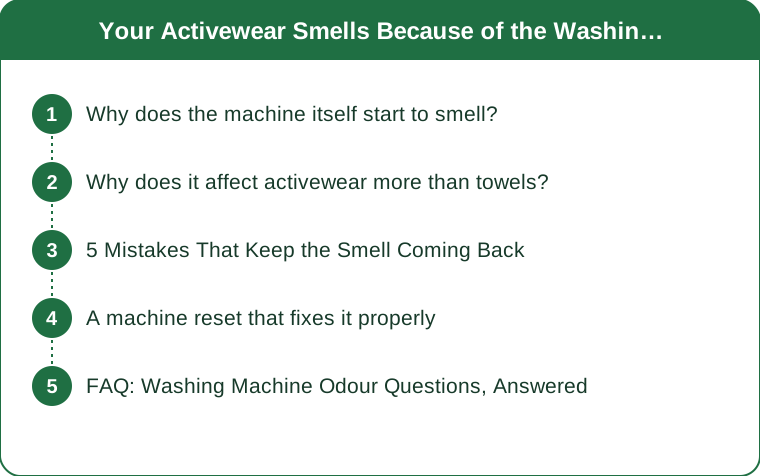
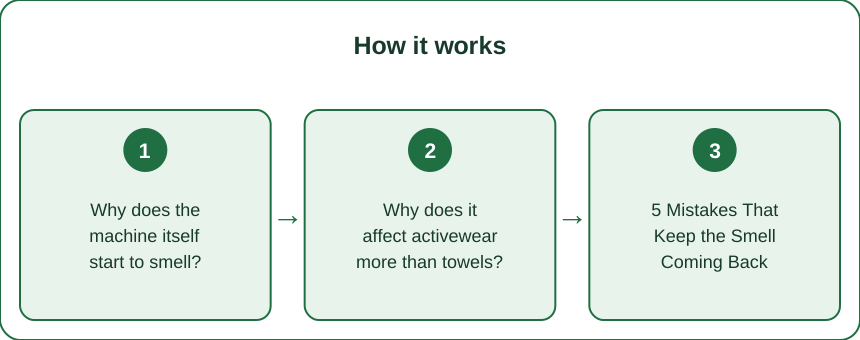
Why does the machine itself start to smell?
Because modern washing habits create close to ideal conditions for biofilm.
Cold washes do not kill much. Thirty degrees is comfortable for most of the bacteria and mould involved, and it is now the default cycle for most households.
Front loaders retain water by design. The door gasket has a fold that holds a small amount of water after every cycle, and the sump never fully drains.
Liquid detergent and fabric softener feed the problem. Both leave organic residue that biofilm grows on, and softener is by far the worst offender.
Biofilm is a physical layer, not loose dirt. Once established it is protected by its own matrix, which is why a rinse or a normal cycle does not remove it.
The door stays shut between loads. A sealed, warm, damp drum is a cultivation chamber, and this single habit is responsible for a large share of machine odour.
And the smell transfers to the load. Every wash circulates water that has passed over the gasket and sump, and some of that lands on your clothes.
Why does it affect activewear more than towels?
Because synthetic fibres and oil chemistry work against you.
Polyester is oleophilic — it attracts oils. Skin oils bind into the fibre in a way they do not with cotton, and odour compounds bind to those oils.
Which means synthetics carry a reservoir of oil that biofilm bacteria find useful, and that ordinary detergent struggles to strip out at thirty degrees.
Cotton absorbs water and releases oils more readily. Towels smell when they are damp and stop smelling when they dry; activewear smells when it warms up, which is a different and more persistent pattern.
The tell is timing. Fabric that smells fine from the drawer and smells musty ten minutes after you put it on is releasing odour as body heat mobilises the oils.
Fabric softener makes it dramatically worse. It coats fibres with a waxy layer that traps oils in and keeps water out, which is why softener on activewear is close to universally advised against.
And high-performance fabrics are often washed coolest of all, because the care label says so, which removes the one thing that would help.

5 Mistakes That Keep the Smell Coming Back
Mistake one: treating the clothes instead of the machine. Vinegar soaks, sports washes and oxygen soaks all help temporarily, and they cannot outrun a machine that re-contaminates every load.
Mistake two: shutting the door after unloading. A closed drum stays damp for hours. Leaving the door and the detergent drawer ajar is free and is the single most effective preventive habit.
Mistake three: never cleaning the gasket fold. Pull the rubber seal back and look. Most people find black residue and standing water on the first inspection, and most have never looked.
Mistake four: ignoring the filter. The pump filter at the bottom front collects lint, hair and water. Left for a year it becomes genuinely foul, and it takes five minutes to empty over a towel.
Mistake five: using fabric softener on synthetics. It coats the fibres, traps oils and reduces wicking. If you use it on other loads, be aware that residue in the drawer and drum still reaches your activewear.
And the one that fixes the most: never running a hot cycle. A monthly ninety degree empty wash, or the machine’s own maintenance cycle, is what actually kills biofilm. Every cold wash between them is neutral at best.
A machine reset that fixes it properly
Six steps, done once, then a monthly habit.
Pull back the door gasket and wipe the whole fold with a cloth and a dilute bleach or a proprietary cleaner. Expect it to be worse than you imagined. Rinse well afterwards.
Remove and wash the detergent drawer in hot soapy water, including the cavity it slides into, which is usually coated in residue.
Open and empty the pump filter at the bottom front, with a shallow tray and a towel underneath. Clean the mesh and check for coins and hair.
Run an empty cycle at ninety degrees with either a machine cleaner or a cup of soda crystals. This is the step that actually kills what is left.
Then run one more empty rinse so nothing from that cycle reaches the next load.
And change the habits: door ajar, drawer ajar, no softener, and one hot wash a month. The maintenance is trivial once the reset has been done.
For the clothes themselves: after the machine is clean, one wash at forty degrees with a full dose of ordinary detergent and no softener usually resolves most garments. Anything still smelling after that has enough oil bound into the fibre to need an enzyme presoak, and a small number of very old pieces will not come back.
FAQ: Washing Machine Odour Questions, Answered
Why does my clean activewear smell as soon as I wear it?
Because odour compounds bound to skin oils in the fibre are released as body heat warms them. If the fabric smells fine cold and musty warm, the oils were never fully removed, and a contaminated machine is the most common reason a normal wash fails to remove them.
How often should I run a hot maintenance wash?
About once a month for most households, more often if you wash mostly cold, use liquid detergent or use fabric softener. Ninety degrees empty, with a machine cleaner or soda crystals, then a rinse cycle before your next load.
Does fabric softener really cause the problem?
It makes it considerably worse. It leaves a waxy coating that traps oils in synthetic fibres, reduces wicking performance, and provides residue in the drum and drawer for biofilm to grow on. Most activewear care labels advise against it for exactly these reasons.
TL;DR:
- Persistent activewear smell is usually machine biofilm, not fabric residue.
- Cold washes, liquid detergent, softener and a closed door together create ideal conditions for it.
- Synthetics hold oils that carry the odour, which is why they smell and towels do not.
- Clean the gasket, drawer and filter, run a hot empty cycle, then leave the door ajar.
Before you replace another pair of leggings, pull back the door seal and look at what is in the fold.
See It in Motion
Seen here: High Waist Embossed Yoga Leggings with Side Pockets — shop it on bubblelime.com
Keep Reading
This article is for general informational and styling purposes only. Fit, sizing, and product availability may vary.