Why Your Activewear Gets So Much Static Cling — and the Actual Fix
Quick Answer: Activewear’s synthetic fibers (polyester, nylon, spandex) hold a static charge far more readily than cotton, and dryer heat strips away the small amount of natural moisture that normally dissipates that charge. Reducing dryer heat, avoiding overdrying, and skipping traditional fabric softener (which can coat the fabric) fixes most static issues.
That sock-to-legging cling straight out of the dryer isn’t just bad luck — synthetic activewear fabric is genuinely more prone to static than the cotton clothes you’re used to, and a couple of laundry habits make the difference.
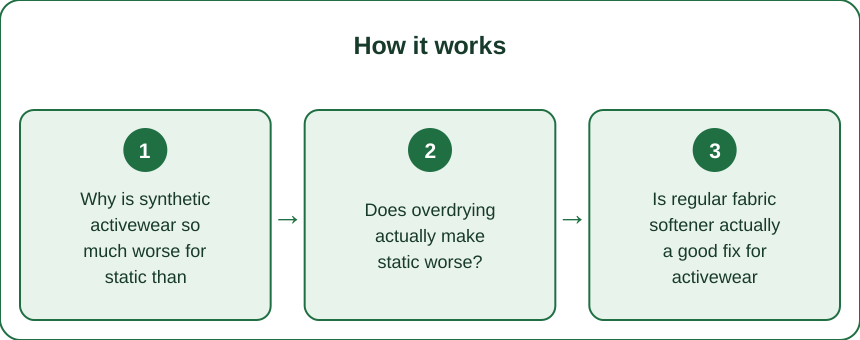
Why is synthetic activewear so much worse for static than cotton?
Cotton is a natural fiber that holds a small amount of ambient moisture, which helps dissipate static charge as it builds. Polyester, nylon, and spandex are synthetic and hold almost no residual moisture, so the friction from tumbling in a dryer builds a charge that has nowhere to go — hence the dramatic cling.
Does overdrying actually make static worse?
Yes, significantly. The drier the fabric gets, the more charge builds during tumbling — pulling activewear out slightly damp, or using a lower heat setting with a shorter cycle, meaningfully reduces static compared to running a full high-heat cycle to bone-dry.
Is regular fabric softener actually a good fix for activewear static?
It reduces static, but at a real cost specific to activewear: traditional fabric softener leaves a light coating on fibers that reduces moisture-wicking performance over time, which defeats the purpose of the fabric. A dryer ball, a small amount of white vinegar in the wash, or simply reducing heat and dry time are better options that don’t compromise performance.
Myth vs Fact: Activewear Static Cling
Myth: All static cling fixes work equally well for any fabric. Fact: Regular fabric softener works fine for cotton but actively degrades activewear’s wicking properties — the fix needs to be fabric-appropriate.
Myth: Static cling is just an unavoidable side effect of synthetic fabric. Fact: Reducing dryer heat and avoiding overdrying meaningfully reduces it without needing any product at all.
FAQ: Activewear Static Cling, Answered
Do dryer sheets damage activewear the same way liquid fabric softener does?
Most dryer sheets contain a similar coating agent, so they carry a similar (though sometimes lesser) risk to moisture-wicking performance over repeated use.
Does air-drying eliminate static entirely?
Yes, essentially — static cling is primarily a dryer-tumbling phenomenon caused by friction and heat, so air-drying activewear removes the issue almost completely.
Is a wool dryer ball actually effective for activewear specifically?
Yes — it reduces static by improving airflow and reducing direct fabric-on-fabric friction during tumbling, without leaving any coating that affects wicking performance.
TL;DR:
- Synthetic activewear fibers hold static far more than cotton because they retain almost no moisture
- Overdrying makes static worse — pull items out slightly damp or use lower heat
- Skip traditional fabric softener on activewear; it coats fibers and reduces moisture-wicking
- Dryer balls, vinegar in the wash, or air-drying are fabric-safe alternatives
A quick change to your drying habits solves activewear static without sacrificing the performance the fabric is actually built for.
See It in Motion
Seen here: Super High Waist Embossed Yoga Leggings with Inner Pocket — shop it on bubblelime.com
Keep Reading
This article is for general informational and styling purposes only. Fit, sizing, and product availability may vary.