Why Indoor-Dried Activewear Smells and How to Stop It
Quick Answer: Indoor-dried clothes smell because drying takes too long. Bacteria and mould keep multiplying on damp fabric, and anything still wet after roughly a day develops that musty note regardless of how well it was washed. Fix the drying speed: space garments out, add airflow with a fan, ventilate the room, and never dry on a radiator in a closed room — that last one adds humidity to the very air that needs to absorb it.
Summer: hung outside, dry in three hours, smells of nothing.
October: draped on a rack in the spare room, still damp at bedtime, smells like a cellar.
Same detergent. Same machine. Different drying time.
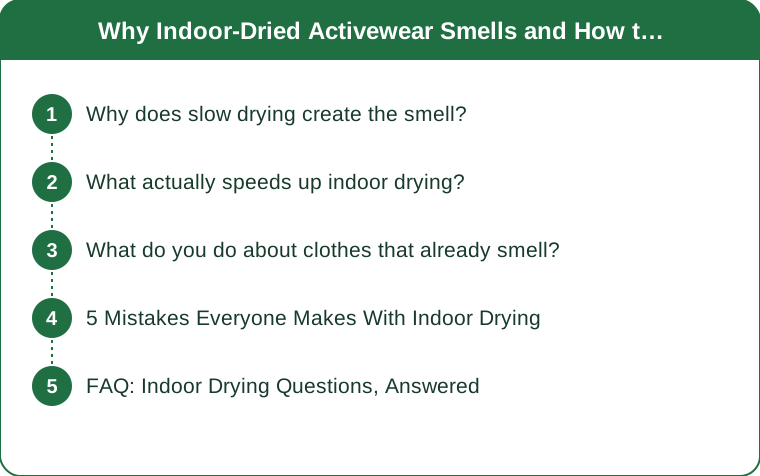
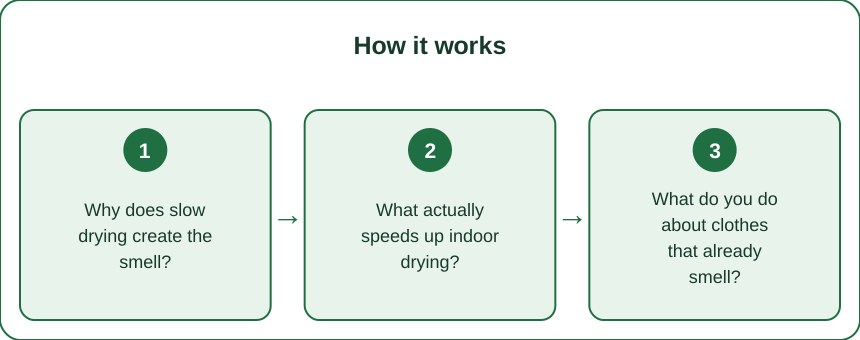
Why does slow drying create the smell?
Because the smell is biological, and biology needs time and moisture.
The musty note is produced by bacteria and mould metabolising residues on damp fabric. A wash removes most of them, not all — and the survivors resume as soon as conditions allow. Conditions means moisture plus time plus warmth, and indoor autumn drying supplies all three generously.
Four things make it worse indoors than out.
No air movement. Evaporation depends on air carrying moisture away from the surface. Still air sits saturated against the fabric and evaporation slows to a crawl, which is why crowded racks in still rooms take days.
High indoor humidity. Once heating season starts, drying laundry indoors raises room humidity substantially — and that humid air then cannot absorb more moisture from your clothes. It becomes self-limiting.
No UV. Sunlight is genuinely antibacterial, and it is a large part of why outdoor-dried laundry smells fresh. Indoors there is none.
And synthetics hold odour differently. Polyester and elastane are oleophilic — they bind body oils more tenaciously than cotton does, and those oils are what the bacteria feed on. This is why the gym top smells and the cotton tee next to it does not.
What actually speeds up indoor drying?
Five changes, in order of effect.
Spin faster before it ever reaches the rack. A higher spin speed removes considerably more water in the machine than any amount of hanging does. Use the highest spin your activewear tolerates — check the label, but most technical fabrics handle 1,000-1,200rpm fine. This is the single most effective step and it costs nothing.
Space garments properly. Every item needs air on both sides. A rack packed edge to edge dries at a fraction of the speed of the same rack half full. Two half-loads on a rack beat one full one, and it takes less total time.
Add a fan. A small fan on low pointed at the rack dramatically shortens drying time, because moving air is what carries moisture away. This is the cheapest single upgrade in the whole of laundry.
Ventilate the room. Cracking a window while things dry lets humid air out. Counter-intuitively, a cool ventilated room dries clothes faster than a warm sealed one, because the sealed room’s air saturates.
Hang on hangers, not folded over a bar. A garment folded over a rail has two damp layers pressed together in the middle, and that fold line is where the smell starts. Hangers, or at minimum draped so no fabric touches fabric.
What do you do about clothes that already smell?
Five steps, in order.
Rewash on the hottest cycle the garment allows. Check the label — many technical fabrics cap at 30-40C, which is not enough to kill much. Where the label allows 60C, use it for this rescue wash.
Add a laundry sanitiser or an oxygen-based additive for fabrics that cannot take heat. These are designed for exactly this problem and work at lower temperatures.
Try a white vinegar rinse — around 120ml in the fabric softener compartment. It helps strip residue and neutralise odour. Never mix it with bleach, and skip it on anything with a waterproof membrane.
Then strip the buildup, because persistent smell usually means detergent and softener residue holding oils. A long soak in warm water with a scoop of oxygen bleach and washing soda, then a plain rinse cycle, clears years of accumulation. Do this two or three times a year, not weekly.
And check the machine itself. A washing machine with a mouldy door gasket recontaminates every load. Wipe the seal, run an empty hot maintenance wash monthly, and leave the door ajar between loads. If everything smells, the machine is the suspect, not the drying.
5 Mistakes Everyone Makes With Indoor Drying
Drying on a radiator in a closed room. It dries the item on that surface and pumps all the moisture into a sealed room, where it settles on cold windows and walls. Mould on the window reveal in October is usually laundry. Use a rack with airflow and ventilation instead.
Using fabric softener on activewear. It coats fibres, reduces wicking, and gives bacteria a residue to live in. It is the single worst product for technical fabric, and it makes the smell problem measurably worse.
Overloading the machine. Clothes need room to move for detergent to reach the fabric and for rinsing to work. An overloaded drum leaves residue, and residue is food.
Leaving the wash sitting in the drum. A finished load left damp for hours has already started developing the smell before it reaches the rack. Move it within an hour — this one habit prevents more musty laundry than any product.
And adding more detergent because things smell. More detergent means more residue means more to feed on. Use less, not more, and add a proper sanitiser if you need one.
FAQ: Indoor Drying Questions, Answered
How long should clothes take to dry indoors?
Aim for under 24 hours. Beyond that, the musty smell becomes likely no matter how clean the wash was.
Does a dehumidifier help?
Yes, considerably — it removes the moisture your clothes are releasing, and a closed room with a dehumidifier dries faster than a ventilated one. It also protects the room from the humidity.
Can I dry activewear on a radiator?
Not ideally. Direct heat can damage elastane, and the humidity goes into the room. A rack near the radiator with airflow is better than on it.
Why does only my gym gear smell?
Synthetics bind body oils more tightly than cotton, and those oils feed odour-causing bacteria.
Will fabric softener help with the smell?
The opposite. It leaves a residue that traps oils and reduces wicking. Avoid it on activewear entirely.
How often should I strip-wash?
Two or three times a year for regularly used activewear, more if you train daily.
Could the smell be coming from my machine?
Yes — check the door seal and detergent drawer for mould, run a monthly hot maintenance wash, and leave the door open between loads.
TL;DR:
- The musty smell is slow drying, not a bad wash. Anything damp beyond a day will develop it.
- Spin faster, space garments out, add a fan, ventilate the room. Airflow beats heat.
- Never dry on a radiator in a closed room — that is how you get mould on the windows.
- No fabric softener on activewear, ever, and move the wash out of the drum within an hour.
- Strip-wash 2-3 times a year, and check the machine’s door seal if everything smells.
Put a fan on the drying rack tonight. It is the change people are most sceptical about and most impressed by.
Keep Reading
This article is for general informational and styling purposes only. Fit, sizing, and product availability may vary.