Getting Fleece and Puffers Out of Storage Without the Musty Smell and Flat Loft
Quick Answer: Flat loft in a puffer comes from long-term compression and, often, accumulated body oils on the down — both fixable with a proper wash and a low-heat tumble dry with dryer balls. Musty smell comes from storing anything even slightly damp in an airtight bag. Fleece that has gone stiff and pilled usually has detergent and fabric softener buildup, which a wash without detergent removes. Do all three in early autumn, not the first cold morning.
A vacuum bag is the worst place to keep a down jacket for five months.

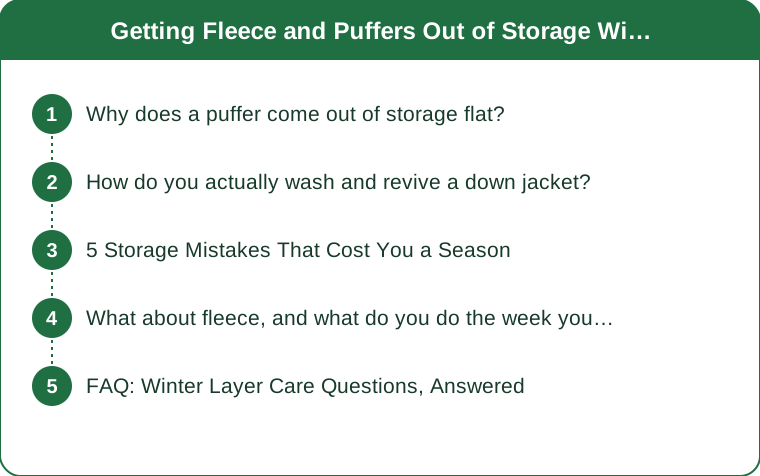
Why does a puffer come out of storage flat?
Compression, oils, and moisture — usually all three at once.
Down insulates by trapping air in its structure. The warmth comes almost entirely from loft, which is the volume the down occupies. Anything that reduces loft reduces warmth proportionally.
Long-term compression damages loft. Down recovers well from short compression — that is what makes it a good travel insulator — but months in a vacuum bag or stuffed into a small sack degrades the clusters over time. This is the single most common storage error.
Body oils weigh the down down. Skin oils transfer through the shell fabric over a season of wear and coat the down clusters, causing them to clump and hold less air. A jacket that feels thin after two winters is frequently just dirty rather than worn out.
Moisture is the third factor. Down is highly sensitive to damp, and a jacket stored with any residual moisture in a sealed bag will smell musty and can develop mildew. That smell is not in the shell, it is in the fill.
Synthetic insulation compresses differently. It resists oil contamination better and loses loft permanently from prolonged compression more readily than down does. A synthetic jacket that has been squashed all summer may not fully recover, which makes correct storage more important, not less.
The diagnosis is simple: hold the jacket to the light. If down has migrated and left visibly empty chambers, it needs washing and redistributing, not replacing.
How do you actually wash and revive a down jacket?
Carefully, with the right detergent, and with a very long dry.
Check the care label first, always. Some technical shells and any jacket with a specialised membrane have specific requirements.
Use a down-specific wash, not ordinary detergent. Standard detergents strip the natural oils that keep down resilient, and residue left in the fill reduces loft. Down washes are formulated to clean without stripping.
Never use fabric softener. It coats fibres, kills loft, and destroys the water repellency of the shell.
Front-loading machine, gentle cycle, cool water. A top loader with a central agitator can tear internal baffles, so use a laundrette front loader if that is what you have at home.
Zip everything, fasten all closures, and turn it inside out.
Run an extra rinse. Residual detergent in the fill is a leading cause of a jacket that never quite regains loft.
Handle it gently when wet. A wet down jacket is heavy and the internal baffles can tear under its own weight. Support it from underneath rather than lifting by a sleeve.
Then dry it properly, which takes hours. Low heat, with three or four dryer balls or clean tennis balls, for as long as it takes — commonly two to three hours or more. The balls break up clumps as it dries.
Take it out and hand-fluff every 30 minutes, separating clumps with your fingers.
It must be bone dry. Any residual damp in the fill will produce mildew and smell. If in doubt, run it longer.
Wash a down jacket rarely — once a season, or when loft is visibly reduced — and it will last many years.

5 Storage Mistakes That Cost You a Season
1. Vacuum bags. They are excellent for space and bad for insulation. Prolonged full compression degrades loft in down and can permanently flatten synthetic fill. Store insulated jackets loosely on a wide hanger or in a large breathable bag.
2. Storing dirty. Body oils, sunscreen, and food residue attract moths, feed bacteria, and set into stains over months. Wash or air everything before storing, especially natural fibres.
3. Sealing anything even slightly damp. The musty smell is almost always this. Everything must be completely dry before it goes into any bag or box, and airtight containers make it worse rather than better.
4. Plastic dry-cleaning bags. They trap moisture and off-gas, and they yellow fabric over time. Cotton garment bags let fabric breathe.
5. Storing in a loft, garage, or basement. Temperature swings and humidity are the enemy. A wardrobe inside the heated part of the house is far better than any of the places people traditionally use.
What about fleece, and what do you do the week you unpack?
Fleece has a different problem: buildup, not compression.
Fleece that feels stiff, less warm, and heavily pilled usually has product buildup. Detergent residue and fabric softener coat the fibres, which mats the pile and stops it trapping air.
The fix is a stripping wash. Run it on a warm cycle with no detergent at all, or with a small amount of white vinegar in place of detergent, and no softener. A single strip wash noticeably restores softness and loft on a fleece that has been washed with softener for years.
Then wash fleece properly from now on: small amount of detergent, no fabric softener ever, low or no heat drying. Heat is what melts and mats synthetic pile permanently.
Pilling is mechanical, not chemical. It comes from abrasion, especially against rough fabrics and in overloaded machines. Wash fleece inside out with similar fabrics, and use a fabric shaver on existing pills rather than picking them.
Your unpacking week routine:
Get everything out in early autumn, not on the first cold morning. You need time to wash and dry things properly.
Hang everything for 24 hours to air. Much of the stale smell disappears on its own.
Shake and hand-fluff every insulated piece, then hang on a wide hanger for a day. Loft partially recovers on its own with air and time.
Tumble anything still flat on low heat with dryer balls for 20 minutes. This alone restores a surprising amount of loft without a full wash.
Check zips, seams, cuffs, and any taped seams, and deal with repairs now while there is time.
Reproof the shells that need it. Water repellency wears off with use and washing, and a wash-in or spray-on treatment restores it — a wet shell over down is a cold jacket regardless of the fill.
Then store the summer things properly, using everything on the mistakes list above, so next May’s unpacking is easier than this one.
FAQ: Winter Layer Care Questions, Answered
Can I wash a down jacket in a normal washing machine?
Yes, in a front loader on a gentle cool cycle with a down-specific wash and an extra rinse. Top loaders with a central agitator risk tearing internal baffles, so use a laundrette machine if that is what you have.
Why is my puffer flat after summer storage?
Usually prolonged compression, sometimes body oils coating the down. Air it, hand-fluff it, and tumble on low with dryer balls; if that does not restore it, wash it properly with a down wash.
How do I get the musty smell out?
The smell comes from storing it slightly damp in a sealed bag, and it lives in the fill rather than the shell. A proper wash followed by a thorough low-heat dry until completely bone dry removes it.
Why has my fleece gone stiff and scratchy?
Detergent and fabric softener buildup coating the fibres. Run it warm with no detergent, or with a little white vinegar instead, and never use fabric softener on fleece again.
TL;DR:
- Flat loft comes from long compression and body oils on the fill; both are usually reversible with a proper wash and a long low-heat tumble.
- Use a down-specific wash, an extra rinse, dryer balls, and dry until completely bone dry — musty smell is trapped moisture.
- Stiff, dull fleece is detergent and softener buildup; strip it with a warm no-detergent wash and never use softener again.
- Vacuum bags, damp storage, plastic covers, and garages are the four storage mistakes that cost you warmth.
Unpack the winter layers this week, not on the first cold morning. Everything on this list needs a day to dry.
Keep Reading
This article is for general informational and styling purposes only. Fit, sizing, and product availability may vary.