Should You Wash New Activewear Before Wearing It? (Yes, and Not for the Reason You Think)
Quick Answer: Yes - wash new activewear before wearing it. New performance fabric carries manufacturing residues including sizing agents, softeners and finishing chemicals that sit on top of the fibers and actively block moisture wicking. One cold wash with a small amount of detergent and no fabric softener removes most of it and measurably improves how the garment performs.
The tags are off and the leggings are already on. Everyone does it, and mostly nothing bad happens.
But the first workout in brand-new gear often feels oddly clammy, and people blame the fabric or the fit.
It is usually neither. It is the coating that fabric arrived wearing.
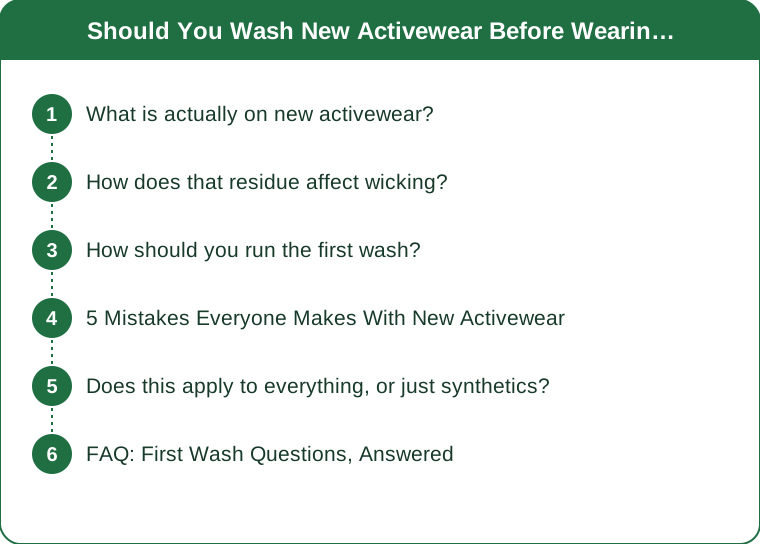
What is actually on new activewear?
More than dye. A new synthetic garment typically carries several categories of residue from manufacturing:
- Sizing agents applied to yarn so it survives high-speed knitting without breaking. These are meant to be removed, and often only partially are.
- Softeners and hand-feel finishes applied to make the fabric feel luxurious on the shelf. These are essentially a thin coating over the fiber surface.
- Anti-wrinkle and anti-static treatments for shipping and display.
- Residual dye that did not fully fix during the dyeing process.
- Handling residue from transport, warehousing, and every person who tried it on before you.
The first three are the ones that matter for performance, because they all do the same thing: they sit between your sweat and the fiber that is supposed to move it.
How does that residue affect wicking?
Moisture wicking is a surface phenomenon. Polyester and nylon do not absorb water - they move it along the outside of the fibers by capillary action, then spread it over a wide area to evaporate.
That entire mechanism depends on the fiber surface being available. A softener coating is hydrophobic by design - it repels water, which is exactly what makes fabric feel silky and exactly what you do not want on a workout garment.
The practical result is that new gear often beads sweat or holds it in one place rather than spreading it. People describe it as clammy, or as the fabric feeling like it stopped working after ten minutes.
It did not stop working. It had not started yet.
How should you run the first wash?
Gently, and specifically not with the products most people reach for:
- Wash separately or with like colors. Excess dye comes off in the first two or three washes, especially in deep and bright colors.
- Cold water, 30C or below. Heat sets any remaining dye and damages elastane.
- A small amount of regular detergent. Not extra - excess detergent is its own residue problem.
- No fabric softener, ever. Softener is the same class of coating you are trying to remove. Using it on activewear is the single most common care mistake there is.
- Skip the dryer. Hang to dry. Heat is what actually kills elastane recovery over a garment’s life.
One pass removes the majority. Full performance often arrives after two or three washes, which is why gear frequently feels better in month two than in week one.

5 Mistakes Everyone Makes With New Activewear
1. Adding fabric softener to make it feel nicer. It coats the fibers, kills wicking, and locks odor in. The nicest-feeling wash is the worst-performing one.
2. Hot washing to sanitize it. Heat sets dye, degrades elastane, and does not remove the finishes any better than cold water with detergent.
3. Using too much detergent. Performance fabrics are dense and hard to rinse. Excess detergent builds up in the knit and is a leading cause of the smell that appears after a few months.
4. Washing a new light-colored piece with a new dark one. The first wash is precisely when excess dye is loose. This is when the white bra gets a permanent grey cast.
5. Tumble drying to speed it up. Elastane loses recovery with heat cumulatively. The first dryer cycle does not ruin anything visibly, and by month six the difference is obvious.
Does this apply to everything, or just synthetics?
It applies most to synthetic performance fabric, but the reasoning shifts by material:
- Polyester and nylon blends: wash first, primarily for the wicking reason above.
- Merino wool: wash first, gently and cold, primarily for handling residue. Merino usually carries less finishing chemistry.
- Cotton blends: wash first for shrinkage - most of a cotton garment’s shrink happens in wash one, and you want that to happen before you decide the fit is right.
- Swimwear: rinse first rather than machine wash. Chlorine-resistant fabrics have surface treatments you want to keep.
- Anything with a bonded seam or printed graphic: cold wash inside out, always.
The universal rules across all of them: cold, minimal detergent, no softener, no dryer.
FAQ: First Wash Questions, Answered
Is there a health reason to wash new clothes?
Skin sensitivity to residual finishing chemicals and dyes is well documented, and it shows up most in tight, sweaty garments - which is exactly what activewear is. If you have ever had unexplained irritation from a new sports bra, this is a likely explanation.
What about clothes bought online versus in-store?
Online items skip the trying-on handling but still carry all the manufacturing residues. The performance argument applies identically.
Will one wash noticeably change how it feels?
Often yes - and sometimes it feels slightly less silky, which is the coating leaving. That is the trade: less luxurious on the hanger, meaningfully better at minute twenty of a workout.
TL;DR:
- New performance fabric carries sizing, softeners, and finishing chemicals that block wicking.
- Wicking is a surface mechanism, so any coating on the fiber defeats it.
- First wash: cold, separately, small amount of regular detergent, no softener, hang dry.
- Full performance often arrives after two or three washes.
- Fabric softener and the dryer are the two things that permanently degrade activewear.
The clammy new-leggings feeling is not the fabric failing. It is a factory coating you can remove in one cold cycle - and the same cycle is the one that decides how the garment ages.
See It in Motion
Seen here: Super High Waist Embossed Yoga Leggings with Inner Pocket — shop it on bubblelime.com
Keep Reading
This article is for general informational and styling purposes only. Fit, sizing, and product availability may vary.