Why Compression Leggings Lose Their Squeeze Faster Than Regular Leggings
Quick Answer: Compression garments rely on tightly engineered elastane fibers under continuous, higher-than-normal stretch tension even during everyday wear, and that sustained tension combined with common washing mistakes — hot water, high heat drying, fabric softener — breaks down elastane’s stretch-recovery ability faster than in regular leggings, which sit at lower baseline tension and recover more slowly from the same care mistakes.
Compression leggings are built to squeeze more than regular leggings from day one, which means the elastic fibers inside are already working harder just sitting in your drawer — and every washing mistake that regular leggings shrug off costs compression garments more.

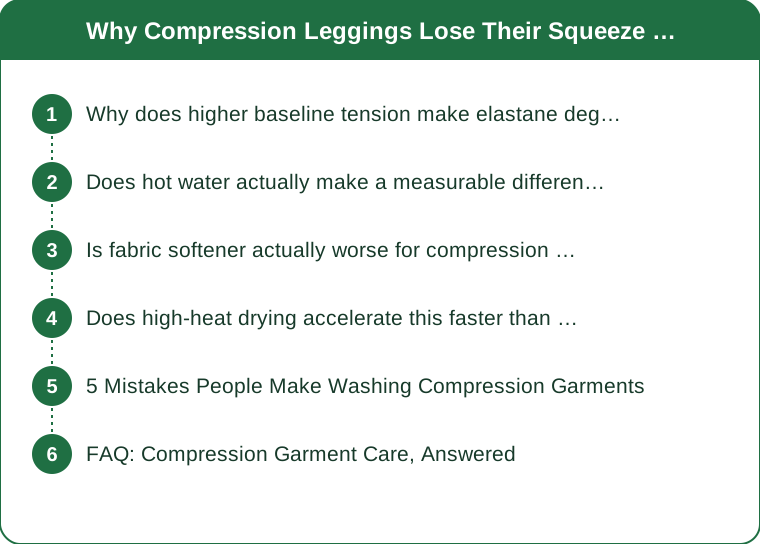
Why does higher baseline tension make elastane degrade faster?
Elastane fibers lose stretch-recovery ability gradually through repeated stretch-and-release cycles and heat exposure, and compression garments are engineered to sit at meaningfully higher tension during wear than standard leggings. That higher constant tension means the same number of wears and washes puts more cumulative stress on the fiber structure than an identical care routine would on lower-tension regular leggings.
Does hot water actually make a measurable difference here?
Yes, significantly — elastane fibers begin losing elasticity at temperatures above roughly 85-90°F (30°C) in regular wash cycles, and this effect compounds on garments already operating at higher tension. Cold water washing preserves compression-level elasticity noticeably longer than warm or hot cycles, more so than the difference matters for a regular, lower-tension legging.
Is fabric softener actually worse for compression garments specifically?
Yes — fabric softener coats fibers with a residue that reduces elastane’s ability to snap back to its original shape, and because compression garments depend on that snap-back more heavily to maintain their functional squeeze (not just fit), the same softener residue that’s a minor issue for regular leggings measurably shortens a compression garment’s functional lifespan.

Does high-heat drying accelerate this faster than air drying?
Considerably — dryer heat is one of the fastest ways to break down elastane’s stretch-recovery structure, and because compression garments are already working at higher tension, repeated high-heat drying cycles compound the damage faster than the same drying habit would on standard leggings. Air drying or a low-heat setting preserves compression significantly longer.
5 Mistakes People Make Washing Compression Garments
1. Washing in warm or hot water instead of cold. This is the single biggest accelerant of elastane breakdown in high-tension garments.
2. Using fabric softener. The residue directly interferes with elastane’s snap-back function.
3. High-heat tumble drying. Heat degrades elastane faster than almost any other single factor.
4. Wearing the same pair for high-intensity workouts on back-to-back days without rest. Constant wear without recovery time between wears adds cumulative stretch fatigue.
5. Ignoring the care label’s specific compression-garment instructions. Compression pieces often have stricter care instructions than standard activewear from the same brand.
FAQ: Compression Garment Care, Answered
How can I tell if compression leggings have actually lost meaningful compression?
If the waistband or overall fit feels noticeably looser than when new, or if you no longer feel the same graduated squeeze sensation during wear, that’s a reasonable sign of reduced compression.
Does hand washing preserve compression better than machine washing?
Often somewhat, mainly because hand washing typically uses cooler water and less mechanical agitation, both of which are gentler on elastane than a machine cycle.
Is there a way to restore lost compression once it’s degraded?
No reliable way to fully restore original elastane recovery once it’s meaningfully broken down — prevention through proper care is the main lever, not a fix after the fact.
TL;DR:
- Compression garments operate at higher baseline tension, making them more sensitive to every washing mistake
- Hot water and high-heat drying both accelerate elastane breakdown faster in compression pieces than regular leggings
- Fabric softener residue specifically undermines the snap-back function compression depends on
- Cold water, air drying, and skipping softener meaningfully extend a compression garment’s functional lifespan
The squeeze isn’t supposed to fade this fast — most of the loss traces back to washing habits that barely matter for regular leggings.
See It in Motion
Seen here: High Waist 8” Yoga Shorts — shop similar styles on bubblelime.com
Keep Reading
This article is for general informational and styling purposes only. Fit, sizing, and product availability may vary.